雅思口语Part 3作为考试的高阶环节,常让考生感到压力倍增,容易出现回答卡顿、内容单薄、逻辑混乱等问题,要突破这一困境,需从问题本质、思维拓展、结构搭建、语言表达等多个维度系统提升。
Part 3回答不好的核心原因分析
Part 3要求考生就抽象话题展开深度讨论,难度远高于Part 2的 personal experience,多数回答不佳的情况可归结为以下四点:
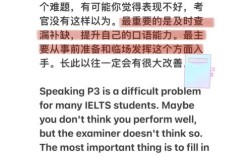
对Part 3的定位认知偏差
许多考生误以为Part 3只需延续Part 2的故事,或简单重复个人观点,Part 3更考察辩证思维、学术化表达及对社会现象的分析能力,当被问“Do you think technology will replace teachers?”时,若仅回答“I think teachers are important because they care about students”,便无法体现对“技术教育功能”与“人文教育价值”的辩证思考,属于定位偏差导致的回答浅层化。
思维拓展能力不足
Part 3话题多为社会热点、抽象概念(如“教育趋势”“文化变迁”“科技影响”),考生常因缺乏相关素材积累,或无法从多角度切入,导致回答内容重复、空洞,讨论“Why do young people prefer online shopping?”时,若仅提到“convenient”和“cheap”,便忽略了消费心理、技术发展、疫情影响等多维度分析,难以展现思维深度。
结构混乱与逻辑断层
Part 3回答需清晰的逻辑框架(如“观点-理由-例子-),但考生常出现“想到哪说到哪”的情况:观点模糊、理由与论点脱节、例子缺乏支撑,回答“Should governments ban private cars?”时,先说“私车造成污染”,突然跳到“私车方便出行”,未说明“如何在环保与便利间平衡”,逻辑链条断裂,让考官难以捕捉核心观点。
语言表达单一化
受限于词汇量和句式储备,考生常使用简单句、重复性词汇(如“good, bad, important”),缺乏复杂句式(如虚拟语气、定语从句)和学术化表达(如“a double-edged sword”“exacerbate social inequality”),表达“老龄化问题”时,只会说“old people are too many”,而无法使用“aging population”“demographic shift”“burden on social security system”等术语,导致语言质感不足。
Part 3高分突破策略
针对以上问题,可从“思维-结构-语言”三方面系统训练,实现回答质量质的飞跃。
(一)思维拓展:从“点”到“面”的立体化分析
Part 3回答的核心是“有内容、有层次”,需通过“多角度拆解”和“深度追问”拓展思路。
多角度拆解话题
遇到抽象话题时,先从“宏观-微观”“个人-社会”“积极-消极”等维度拆解,以“Why do people pursue higher education?”为例:
- 个人维度:职业发展(提升专业技能、增加就业竞争力)、自我实现(拓宽知识面、培养批判性思维)、社会地位(获得学历认可、拓展人脉资源);
- 社会维度:推动科技进步(高等教育培养科研人才)、促进经济转型(高学历劳动力支撑产业升级)、文化传承(通过学术研究保存历史文明)。
通过维度拆解,可将单一问题拓展为3-4个分论点,避免内容重复。
深度追问法(5W1H)
对每个分论点用“Why/What/How/When/Where/Who”追问,挖掘深层原因和具体表现,针对“higher education promotes career development”,可追问:
- Why?(因为企业对专业能力的要求提高,学历是筛选人才的基本门槛);
- How?(通过专业课程、实习机会、校企合作等途径积累实践经验);
- What?(具体表现为薪资水平高于低学历群体、晋升机会更多)。
通过追问,可将抽象论点具体化,回答更具说服力。
(二)结构搭建:框架先行,逻辑清晰
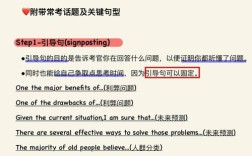
Part 3回答需“开门见山+分层论证+总结升华”,建议采用“总-分-总”结构,确保逻辑连贯。
开头:明确观点+预览分论点
用1-2句话直接回应问题,并简要说明将从哪几个角度展开。
“I believe higher education serves multiple purposes, not only for individual career growth but also for societal progress. Specifically, it enhances professional competence, fosters personal development, and contributes to economic innovation.”
(观点:高等教育有多重作用;分论点:职业能力、个人发展、经济创新)
主体:分层论证+细节支撑
每个分论点单独成段,采用“主题句+解释+例子+影响”的展开方式,论述“enhances professional competence”:
- 主题句:“Firstly, higher education equips individuals with specialized knowledge and practical skills required in modern industries.”
- 解释:“Unlike vocational training, university programs combine theoretical foundations with hands-on projects, such as laboratory research or case studies, which cultivate problem-solving abilities.”
- 例子:“For instance, engineering students learn to design sustainable solutions through teamwork, simulating real-world workplace scenarios.”
- 影响:“This makes graduates more competitive in fields like technology and manufacturing, where employers prioritize both expertise and collaboration skills.”
通过“主题句+细节支撑”,每个段落逻辑严密,内容充实。
总结观点+升华意义
用1-2句话重申核心观点,并延伸至更宏观的层面。
“In conclusion, while higher education is often seen as a pathway to personal success, its true value lies in empowering individuals to drive societal advancement. As the job market evolves, investing in education remains crucial for both individual fulfillment and national development.”
(高等教育对个人和社会都重要;升华:应对就业市场变化,教育是国家发展的关键)
(三)语言表达:学术化与多样化
词汇升级:避免口语化重复
用具体、学术的词汇替代笼统表达。
- “good” → “beneficial, advantageous, conducive to”
- “bad” → “detrimental, harmful, counterproductive”
- “important” → “crucial, vital, instrumental in”
- “many people” → “a growing number of individuals, the majority of the population”
句式多样化:长短句结合,复杂句点缀
交替使用简单句、并列句和复杂句,避免单调。
- 简单句:“Technology has changed education.”
- 并列句:“Technology has changed education, and it has also made learning more accessible.”
- 复杂句:“While some argue that technology may reduce face-to-face interaction, it undeniably provides students with instant access to global resources, thereby democratizing education.”
连接词:强化逻辑衔接
使用连接词明确段落间和句子间的关系,使回答更流畅。
- 转折:“however, nevertheless, on the contrary”
- 因果:“therefore, thus, consequently, as a result”
- 递进:“furthermore, moreover, in addition”
- 举例:“for instance, for example, to illustrate”
实战案例对比:低分回答 vs 高分回答
话题:Do you think artificial intelligence will replace human teachers?
低分回答(约80词)
“I think AI cannot replace teachers. Because teachers care about students, they can give emotional support. AI is just a machine, it doesn’t have feelings. Also, teachers can answer students’ questions, but AI may not know some special questions. So teachers are better than AI.”
问题分析:观点单一、无逻辑框架;语言简单(重复“teachers”“AI”);例子缺乏细节(未说明“特殊问题”具体指什么)。
高分回答(约200词)
“While AI has undoubtedly transformed educational tools, I believe it cannot fully replace human teachers due to three key limitations.
Firstly, teaching is not merely about knowledge transmission but emotional guidance. Adolescents, in particular, often need empathy and encouragement to overcome academic stress—something AI, lacking emotional intelligence, cannot provide. For example, a student struggling with family issues may find comfort in a teacher’s counseling, but an AI chatbot would only offer standardized responses.
Secondly, human teachers excel at adapting to unexpected situations. Suppose a student asks a question that deviates from the curriculum, a skilled teacher can connect it to the student’s interests and real-life examples, fostering critical thinking. AI, however, operates within pre-programmed parameters and struggles with such dynamic interactions.
Finally, education aims to nurture well-rounded individuals, not just exam-takers. Teachers inspire values like creativity and resilience through storytelling and personal experiences, which AI cannot replicate. In conclusion, AI should be seen as a complementary tool to enhance teaching, not a substitute for human educators.”
优势分析:
- 结构清晰:总-分-总结构,三个分论点(情感支持、灵活应变、价值观培养)逻辑递进;
- 思维深度:从“知识传输”到“情感教育”“能力培养”多维度分析,避免非此即彼;
- 语言丰富:使用“emotional intelligence”“pre-programmed parameters”“well-rounded individuals”等学术词汇;复杂句(如“Suppose a student asks...”)和连接词(“firstly, finally, in conclusion”)增强连贯性;
- 例子具体:结合“青少年心理”“课堂突发提问”等真实场景,具象化抽象观点。
FAQs
Q1: Part 3回答时,说“我不知道”会影响分数吗?
A: 直接说“I don’t know”会显得准备不足,但可通过“转述问题+合理推测”化解尴尬。“That’s an intriguing question. While I’m not an expert in this field, I believe it relates to... From what I’ve observed, one possible reason is...” 这样既展现态度,又能延续回答。
Q2: Part 3需要背模板句吗?
A: 不建议死记硬背模板,但可积累“万能逻辑框架”(如“利弊分析”“原因-影响-解决方案”“对比观点”)和“功能句型”(如表达观点、举例、转折),关键是结合具体话题灵活运用,避免生搬硬套导致回答机械化。