掌握地道的句式表达,是雅思写作突破瓶颈、获取高分的关键,许多考生积累了丰富的词汇,却在组织语言时显得生涩平淡,本文将系统梳理实用句式,并探讨如何将其灵活融入文章,从而有效提升写作的流畅性与学术性。
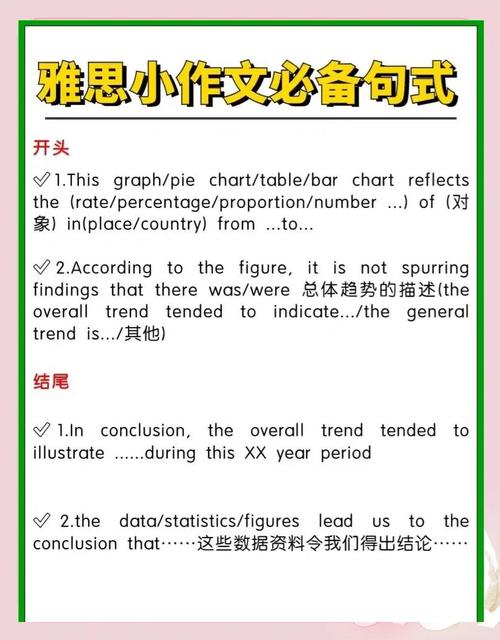
开篇引言句式
文章开头需直指主题,明确立场,避免使用“随着社会发展”等空洞表达,而应采用更具体、有力的方式。
- 背景引入法:在讨论科技、教育等普遍话题时,可先勾勒普遍认知。
- “In the contemporary era, the impact of digital technology on human interaction has become a subject of intense debate.”
- 又如:“The issue of whether environmental protection should take precedence over economic development continues to divide public opinion.”
- 观点对立法:直接呈现争论双方观点,凸显讨论价值。
“While some argue that globalization erodes cultural diversity, others contend that it fosters greater understanding and integration among nations.”
- 设问切入法:通过问题引发读者思考,自然引出自身论述。
“What defines a successful life? Is it material wealth, career achievement, or personal fulfillment? This essay will argue that true success lies in a balance of all these aspects.”
 (图片来源网络,侵删)
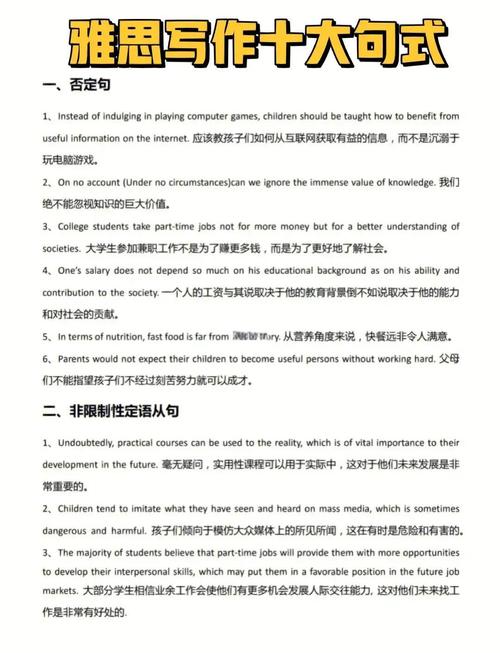
论证主体句式
主体段落需要清晰呈现观点,并提供逻辑支撑,句式应体现分析的层次和深度。
-
提出分论点
- “A primary reason for this is that...”(一个主要原因是…)
- “The most compelling argument in favor of... is...”(支持…最有力的论据是…)
- “This phenomenon can be largely attributed to...”(这一现象很大程度上可归因于…)
-
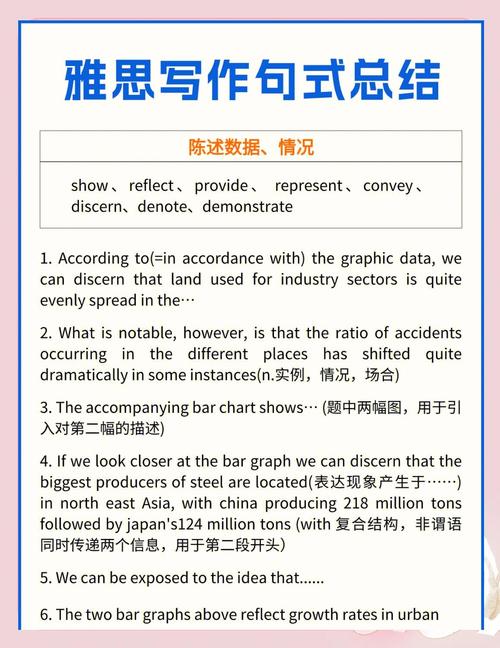
展开论述与举例
 (图片来源网络,侵删)
- “To illustrate, consider the case of...”(考虑一下…的情况)
- “This is particularly evident in the field of..., where...”(这在…领域尤为明显,)
- “Take... as an example; it demonstrates how...”(以…为例,它展示了…如何…)
- 注意:举例后务必跟进解释,使用“This example clearly shows that...”或“Thus, it can be seen that...”将例子与论点紧密扣合。
-
对比与让步
- 对比:“In contrast to..., ...”(与…相反,…)
- 让步:“Admittedly, it is true that... However, this does not invalidate the argument that...”(诚然,…确实如此,这并不能否定…的观点。)
- 反驳:“Critics may claim that... Nevertheless, a closer examination reveals that...”(批评者可能声称…,更仔细的研究表明…)
-
分析影响与结果
- “Consequently, this leads to a chain reaction of...”(这引发了一系列的…)
- “As a result, not only does... but also...”(结果,不仅…)
- “The potential implications of this trend are far-reaching, affecting both... and...”(这一趋势的潜在影响是深远的,既影响…也影响…)
衔接与连贯句式
句子与段落间的流畅过渡是逻辑清晰的保障,也是评分标准中“连贯与衔接”项的重点。
- 并列与递进:“Furthermore,” “Moreover,” “Additionally,” “Similarly.”
- 因果与结果:“Therefore,” “Thus,” “Hence,” “As a consequence.”
- 转折与对比:“However,” “On the other hand,” “Conversely,” “Despite this.”
- 强调与总结段落内观点:“In essence,” “That is to say,” “This underscores the point that...”
结尾结论句式
结尾应重申核心立场,总结主要论点,并可进行适度升华,避免简单重复开头。
- 总结观点法:“In conclusion, the evidence presented strongly supports the view that...”(所提出的证据有力支持了…的观点。)
- 权衡利弊法:“Ultimately, while both sides have merit, the advantages of... appear to outweigh its disadvantages.”(尽管双方都有道理,但…的利似乎大于弊。)
- 展望建议法:“Given the analysis above, it is reasonable to recommend that...”(鉴于以上分析,有理由建议…)
注意:建议需简洁、合理,与文章论述范围相符。
从模仿到内化:运用句式的核心原则
单纯背诵句式模板易导致文章生硬,真正提升在于理解原理并灵活运用。
- 准确性优先:确保所使用的句式与你想表达的逻辑关系(因果、对比、让步)完全匹配,用错逻辑连接词会严重损害文章可读性。
- 多样性体现:同一段落内,避免反复使用“Firstly, Secondly”,可交替使用“One primary reason is...”, “Another significant factor to consider is...”, “Beyond that,...”等表达。
- 语境适配性:学术写作需保持正式、客观的语气,避免口语化缩写(如don’t, can’t)和过于情绪化的词汇,所有举例和论证都应为支撑核心论点服务,保持论述的严谨。
- 练习与复盘:选择高频话题,有意识地将所学句式应用于段落写作中,完成初稿后,专门检查句式的运用是否恰当、多样,并进行修改优化,通过大量有针对性的练习,将这些句式转化为自己的语言习惯。
写作能力的提升是一个积累与反思并进的过程,掌握这些句式框架,如同获得了构建文章的精良工具,但真正让文章焕发光彩的,始终是清晰有力的思想与严谨缜密的逻辑,将句式作为思想的载体,而非装饰,才能在雅思写作中展现出扎实的语言功底与批判性思维,从而获得理想分数,持续练习,用心打磨,每位考生都能在写作中自信、准确地表达自己的观点。