托福口语Task 4是综合口语任务的一部分,要求考生先阅读一篇约100词的学术短文,内容涉及心理学、社会学、生物学等常见学科概念,随后听一段约1分30秒的课堂讲座,教授会用具体例子解释阅读材料中的概念,考生需在60秒内结合阅读和听力信息,用完整句子复述核心概念及对应例子,考察信息整合、转述及口语表达的逻辑性与准确性,以下从任务结构、解题步骤、高分策略、常见误区及实例解析五个维度展开详细分析。
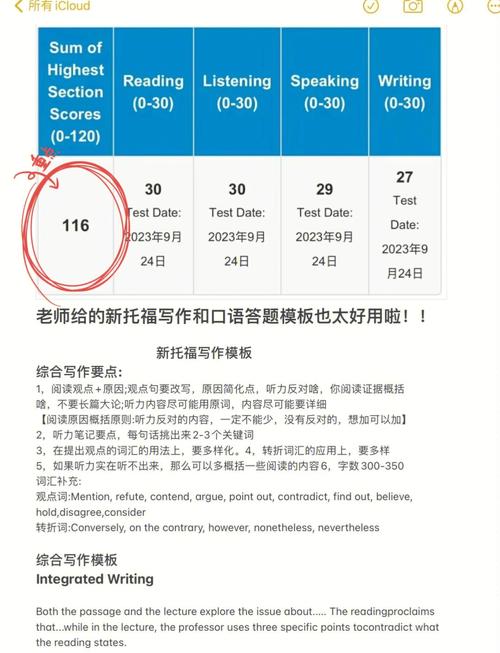
任务结构与核心要求
Task 4的阅读材料通常以“概念定义+特征说明”为主,“Cognitive Dissonance(认知失调)指个体同时持有相互矛盾的信念或行为时产生的心理不适感,为缓解这种不适,人们可能改变信念、行为或增加新认知。”听力部分则由教授用1-2个具体场景(如学生经历、实验案例、社会现象)拆解该概念,“学生A明知熬夜有害却熬夜打游戏,为缓解认知失调,他开始相信‘偶尔熬夜不会影响健康’。”考生需在回答中明确三点:①阅读中提出的核心概念;②教授解释该概念的具体例子;③例子如何体现概念逻辑。
分步解题策略与实操技巧
阅读阶段:高效抓取关键信息(45秒)
- 定位核心概念:首句通常为定义句,划出下划线(如上例“Cognitive Dissonance”),这是回答的“题眼”。
- 标记特征关键词:用符号标注概念的关键特征(如“心理不适感”“缓解方式:改变信念/行为/增加认知”),避免遗漏听力中对应逻辑。
- 预判听力方向:根据阅读内容推测教授可能举的例子类型(如学生生活、历史事件、实验数据),提前激活相关词汇库。
听力阶段:分层记录逻辑链(1分30秒)
- 主旨句定位:教授开头常以“In other words”“To put it simply”重述概念,需记录同义替换(如“心理不适感”记为“uncomfortable feeling”)。
- 例子分层记录:用“例子1+细节1+细节2”结构整理,
- 例子主体:Student A, stay up playing games
- 矛盾点:Knows harmful vs. does it anyway
- 缓解方式:Changes belief (“occasional熬夜无害”)
- 逻辑连接词标注:记录“because”“so”“for example”等词,帮助口语回答体现因果关系(如“He changed his belief because he felt uncomfortable”)。
口语表达:30秒框架搭建与内容填充
- 黄金结构模板:
“The reading discusses [核心概念], which is defined as [概念定义]. In the lecture, the professor explains this concept by using an example of [例子主体]. Specifically, [例子细节1]. However, [矛盾点/冲突]. As a result, [如何体现概念/结果].” 取舍原则**:优先保留“概念定义+例子主体+关键矛盾+结果”,细节描述可简化(如“stay up playing games”简化为“stay up gaming”)。 - 语言优化技巧:
- 避免直接背诵原文,用同义替换(如“individuals”→“people”, “alleviate”→“reduce”);
- 加入逻辑连接词(“first”, “then”, “finally”)使层次清晰;
- 控制语速(约120-150词/分钟),确保60秒内完成内容。
高分要素与常见失分点
高分要素
| 维度 | 具体要求 | |------------|--------------------------------------------------------------------------|完整度 | 包含概念定义、例子细节、逻辑关系,缺一不可 | | 信息准确度 | 听力细节(如人名、数字、行为)无偏差,概念理解不跑题 | | 语言表达 | 句式多样(简单句+复合句交替),用词准确,语法错误少(如主谓一致、时态) | | 流利度 | 停顿不超过2秒/处,无频繁重复或自我纠正 |
常见失分点
- 信息遗漏:只讲例子不提概念,或只复述阅读忽略听力细节;
- 逻辑混乱:因果关系颠倒(如“He changed his belief, so he felt uncomfortable”);
-语言问题:中式英语(如“I very like this example”)、过度使用简单句(连续5个“I...”开头的句子); - 时间失控:前30秒铺垫过多,例子部分没讲完。
实例解析:以“Observational Learning(观察学习)”为例
阅读材料(节选)
Observational learning, a concept from social cognitive theory, refers to acquiring new behaviors by watching others. It involves four key elements: attention, retention, reproduction, and motivation. For example, a child might learn to tie shoes by observing a parent.
听力材料(教授讲解)
In my psychology class, we discussed a study about observational learning. A researcher observed a group of children and a Bobo doll—a toy that bounces back when hit. First, the children watched an adult aggressively hit the Bobo doll, yelling “Hit him!” (attention). Later, the children were left in a room with the Bobo doll. Many imitated the adult’s behavior: hitting the doll and yelling (retention + reproduction). However, some children didn’t hit the doll—they received no motivation, like praise or rewards. So motivation is crucial too.
参考回答(58秒)
The reading introduces observational learning, which means learning new behaviors by watching others, and it requires attention, retention, reproduction, and motivation. The professor uses an example with children and a Bobo doll to explain this. First, the children watched an adult hit the doll and yell, which is the attention stage. Then, when they were in the room alone, many copied the adult’s behavior—hitting the doll and yelling—so they retained the behavior and could reproduce it. But some children didn’t do it because they had no motivation, like rewards. This shows all four elements are necessary for observational learning.
备考建议
- 材料精练:使用TPO真题,重点分析听力例子与阅读概念的对应逻辑,记录教授常用举例句式(“One time I saw...”“There was a study where...”)。
- 限时训练:从45秒阅读+90秒听力后开始计时口语,逐步压缩至60秒,避免超时。
- 反馈修正:录音后自查:是否包含三要素?逻辑是否连贯?语法错误是否超2处/句?可参考高分范例调整表达。
FAQs
Q1:Task 4中,如果听力例子和阅读概念不完全一致,如何处理?
A1:优先确保听力例子的准确性,即使与阅读表述略有差异,只要逻辑一致即可,阅读定义“认知失调”为“矛盾信念导致不适”,听力例子为“明知吃甜食有害却吃,后安慰自己‘偶尔没事’”,此时需强调“矛盾行为(吃有害食物)→心理不适→通过改变信念缓解”,而非纠结于“信念”和“行为”的细微差别,核心是体现“如何缓解认知失调”。
Q2:口语回答中,如何避免简单句堆砌,提升句式多样性?
A2:可通过合并信息、使用从句或连接词实现,简单句堆砌:“The professor gave an example. A child watched a parent. The child learned to tie shoes.” 优化后:“The professor illustrated this with an example where a child learned to tie shoes after watching a parent demonstrate the process.”(使用时间状语从句)或 “The example, involving a child and a parent, showed how observation leads to learning.”(使用分词结构),日常积累“while”, “which”, “as a result of”等连接词,替换“and”“so”等基础词汇,能有效提升句式丰富度。