TOEFL口语模板:高效备考与实战应用
TOEFL口语考试是许多考生备考中的难点,尤其是时间压力大、话题灵活多变的特点,让不少考生感到无从下手,一套科学、高效的口语模板便成为突破瓶颈的关键工具,本文将系统介绍TOEFL口语模板的分类、设计原则、具体应用场景及注意事项,帮助考生在考试中快速组织语言,提升表达的流畅性与逻辑性。

TOEFL口语模板的分类与适用场景
TOEFL口语考试包含独立口语(Task 1-2)和综合口语(Task 3-6)两部分,不同任务类型对语言组织能力的要求差异较大,因此模板需针对性设计。
-
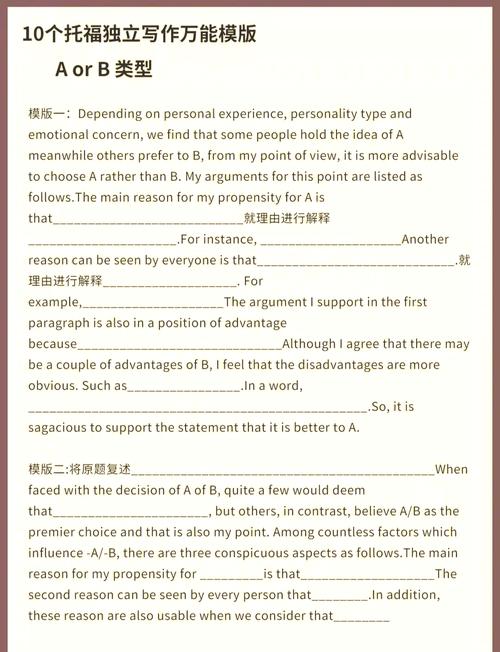
独立口语模板(Task 1-2)
独立口语要求考生就熟悉话题发表个人观点,模板需突出“观点明确、论据充分”的特点。- 观点引入句:
- "In my opinion, [观点] is the most significant choice."
- "From my perspective, [主题] plays a vital role in daily life."
- 论据展开句:
- "Firstly, [论据1] supports my viewpoint because..."
- "Moreover, [论据2] demonstrates that..."
- 结论总结句:
"Therefore, considering all these factors, I firmly believe that..."
适用场景:Task 1(个人偏好)、Task 2(二选一)等需要快速表态的题目。
 (图片来源网络,侵删)
 - 观点引入句:
-
综合口语模板(Task 3-6)
综合口语需整合阅读、听力材料中的信息,模板需强调“信息提取、逻辑串联”。- 概括:
"According to the reading passage, the university plans to [措施] due to [原因]."
- 反驳/支持:
- "However, the speaker disagrees with this proposal for two reasons."
- "First, he mentions that [细节1], which contradicts the reading."
- 总结句:
"In conclusion, the speaker’s arguments effectively challenge the reading’s proposal."
适用场景:Task 3(校园议题)、Task 4(学术讲座)等需转述信息的题目。
 (图片来源网络,侵删)
 - 概括:
模板设计原则:避免僵化,注重灵活
模板并非万能公式,过度依赖可能导致表达机械化,以下是设计模板的核心原则:
- 模块化结构:将模板拆分为“开头-主体-三大模块,每个模块预留关键词填空位置(如[观点]、[论据]),便于根据题目灵活替换内容。
- 多样化表达:同一功能句式准备2-3种替代方案,避免重复。
表达观点:"I believe that..." / "From my point of view..." / "It seems to me that..."
- 控制时长:独立口语模板需压缩在45秒内,综合口语模板需严格对应60秒要求,避免超时或内容不足。
高频模板句式与实战应用
以下是针对不同任务类型的高频模板句式,结合具体题目示例说明:
独立口语(Task 1:选择类题目) "Some students prefer to study alone, while others prefer to study in a group. Which do you prefer?"
模板应用:
- 开头:"I prefer studying in a group because it enhances learning efficiency."
- 主体:"Firstly, group discussions allow me to clarify doubts by exchanging ideas with peers. For example, when solving math problems, classmates often provide shortcuts I haven’t thought of. Secondly, studying in a group motivates me to stay focused, reducing procrastination."
- "Thus, despite the need for coordination, the benefits of group study make it my top choice."
综合口语(Task 4:学术讲座) 阅读+听力):阅读介绍“生态位”(niche)概念,听力以鸟类为例说明。
模板应用:
- 阅读概括:"The reading defines a niche as the role a species plays in its environment, including its food sources and habitat."
- 听力连接:"In the lecture, the professor illustrates this with two bird species: the warbler and the nuthatch. The warbler feeds on insects in tree tops, while the nuthatch searches for bark insects. Their different niches reduce competition."
- "Therefore, the example of these birds demonstrates how niche specialization allows species to coexist."
模板使用的注意事项
- 避免背诵痕迹:模板需自然融入个人语言风格,避免生硬套用,可将模板句式与日常口语习惯结合,如用 "That’s why I think..." 替代 "Therefore, I believe..."。
- 强化逻辑连接词:使用 "furthermore"、"consequently" 等词汇增强段落连贯性,但需避免堆砌。
- 结合真题练习:通过TPO(TOEFL Practice Online)模拟题,将模板应用于真实场景,检验适用性并调整优化。
模板优化与个性化调整
考生可根据自身强弱项调整模板重点。
- 逻辑薄弱者:增加“因果-对比”类句式,如 "The primary reason is that... / On the contrary..."。
- 词汇量不足者:替换模板中的高频词(如 "important" → "crucial/essential")。
以下为模板优化对比表:
| 优化方向 | 原始模板句式 | 优化后句式 |
|---|---|---|
| 词汇升级 | "This is a good way." | "This approach proves highly effective." |
| 逻辑强化 | "First, second, third." | "Initially, ... / Subsequently, ... / Ultimately, ..." |
| 口语化表达 | "In conclusion, I think..." | "So, all in all, I’d say..." |
相关问答FAQs
Q1:使用模板是否会被考官识别并扣分?
A:TOEFL口语评分注重内容的逻辑性与语言的自然度,而非模板本身,只要模板使用灵活(如关键词替换、句式多样化),且能准确回应题目要求,就不会被扣分,建议避免直接使用网络模板,而是根据自身表达习惯调整。
Q2:如何在1分钟内快速组织模板内容?
A:通过“预判题目类型+提前准备模块”实现高效应用。
- 独立口语:考前积累10个高频话题(如科技、教育)的核心观点库,考试时直接调用。
- 综合口语:练习“3秒抓关键词”能力(如阅读中的“措施”、听力中的“态度”),快速填充模板框架。
TOEFL口语模板是备考的“脚手架”,而非“最终答案”,考生需在理解模板逻辑的基础上,通过大量练习实现从“套用”到“活用”的蜕变,最终在考场上展现自然、流畅的表达能力。